Vin Diesel on D&D and Riddick

  • Subscribe to our RSS feed.
  • Twitter
  • StumbleUpon
  • Reddit
  • Facebook
  • Digg
Showing posts with label DMing tricks. Show all posts

Friday, 31 May 2013

Wikipedia is the GM's Friend: Hanna-Barbera Adventure Cartoons

Posted on 10:47 by rajrani
For most of the latter half of the twentieth century, animation studio Hanna-Barbera absolutely dominated television animation. They're best remembered for shows like the Flintstones, Scooby Doo, and the Smurfs, but they had a large stable of adventure-type shows that were full of action, had humor without being wacky, and could definitely serve as inspiration for the game master in need of a quick jolt. The full list of H-B cartoon shows is massive. I loved these things when I was growing up, and they would definitely be a part of my own personal Appendix N.

The first, of course, was Jonny Quest. The title character, the young son of scientist Dr. Benton Quest, would fly around the world with his father, his father's partner Race Bannon, and his friend Hadji, solving all sorts of problems and foiling evil. And their dog Bandit, too, of course...

Then there was Space Ghost (the original, serious one). It actually consisted of two different cartoons; Space Ghost, with the futuristic super hero and his two proteges, and Dino Boy in the Lost Valley, which was a sort of Lost World homage with cave men, dinosaurs, and a young boy getting into and out of various perils.

Birdman and the Galaxy Trio came next, with superhero Birdman (again, the original, serious, one) fighting various villains in one half of the show, and the Galaxy Trio, an otherwise forgettable threesome of outer space superheroes doing likewise.

The Herculoids was somewhat high-concept for its day; it's set in the future, on an alien planet, but the protagonists are a family from a high-tech society that have decided to settle on a savage planet and live a primitive lifestyle, and defend the planet against technological encroachments. There are a bunch of different intelligent races on the planet, and there are many opportunities for peril, as well as the family's collection of semi-sentient alien-companions. There were a few crossovers with Space Ghost, if I remember correctly.

Shazzan is one of my personal favorites, a riff on Aladdin, with a brother and sister who together can summon the genie Shazzan. The kids seem to be from the modern world, but the series is set in a very fantastic Arabian Knights sort of setting. The plots are interesting, up to the point where they wrap up with the kids putting their rings together and having the genie save the day.

Mightor was one of the segments in the Moby Dick and Mighty Mightor show, which featured a prehistoric superhero (complete with secret identity) foiling various villains seeking to harm the peaceful inhabitants of a prehistoric village.

The Banana Splits Adventure Hour consisted not only of the costumed rock band playing some (actually fairly decent) songs and telling jokes, but with four recurring series as well; the Arabian Knights, which featured a band of good-hearted rogues (actually, a strongman, a magician, an acrobat prince seeking to get his throne back, his cousin who is an expert in disguise, and a shape-shifter) trying to overthrow the evil usurper of Baghdad, Danger Island, which featured a family shipwrecked on an island with pirates, dangerous animals, and savages who liked to paint their bodies like skeletons; and the Three Musketeers, which was pretty much as the name implies. There was also a fourth, Micro Ventures, which was pretty dull, and consisted of the family being shrunk down to very small size and using their dune buggy to escape now-giant ants.

The Adventures of Gulliver featured the titular character seeking a treasure, with an evil pirate trying to get the map from him, always foiled by the tiny people of Lilliput.

Sealab 2020 (once again, the original, not the later parody) was a neat science fictiony type adventure series, centered around an underwater research station. This was about the last of Hanna-Barbera's "serious" adventure shows.

After this point, they stuck with the predictable formula of cheap gags and silly situations (with the exception of the truly amazing Pirates of Dark Water, which deserves a post of its own), but for a time there in the 1960's and 70's, they had a great raft of solid adventure stories that could definitely serve as inspiration for a game today.

And with that, I leave you with this über-cool boardgame-themed Jonny Quest promo from Boomerang...


__________

Also, please don't forget the Adventures Dark and Deep Bestiary Kickstarter has just one more day to go! 900 monsters, suitable for most OSR-type games, all under one cover. Can you help get us to having an illustration for each and every one?
Read More
Posted in DMing tricks, RPG | No comments

Tuesday, 21 May 2013

Wikipedia is the DMs Friend: Medieval Demographics

Posted on 13:11 by rajrani
Most (A)D&D worlds are generally sparse in population, with but a single village in an entire 30-mile hex, if that. Many find that sort of emptiness unsatisfying from an historical perspective, and seek to beef up their worlds' population accordingly.

Many are probably already familiar with S. John Ross's excellent Medieval Demographics Made Easy page. In it, he crunches a bunch of numbers and comes up with likely numbers of people, occupations, population densities, and so forth. If you haven't read it, it's worth the time.

There's also an excellent and informative Wikipedia article on the subject of Medieval demographics. While it is not (obviously) focused on the sorts of data that would be most of use for RPG world-building, it does have a broader overall picture, stressing that demographics in Medieval Europe went through several booms and crashes over the centuries.

England in 1335 or 1365? It matters...
One of the interesting points I see there that would be suitable for the implied D&D setting is the High Middle Ages, where we see the "great clearances" of woodland and the expansion of agriculture. That would be a ripe time for isolated settlements in the wilderness, whose inhabitants are in the process of clearing away woodlands and badlands for farming, and in the process uncovering all sorts of long-forgotten stuff and disturbing all sorts of Things Best Left Undisturbed.

The period immediately following the Black Death would be an interesting RPG setting as well. Whole regions would be depopulated as people reorganized themselves, leaving behind towns and villages quickly falling into ruin, and into which long-displaced humanoids and monsters might creep to retake the lands taken from them so long ago. There might be lots of things out there in the newly-encroaching wilderness worth recovering, which gives a ready-made excuse for adventuring.

It should be remembered that Tolkien's Middle Earth similarly suffered a Great Plague in the Second Age. That's one reason you see all those old ruins scattered around everywhere in the films.

Think not just about what the demographics are in your campaign, but what the trend is. Are people expanding, and wildernesses therefore shrinking? Or is the reverse happening? Adventure is found in times of change, after all, and the type of change will shape the type of adventure to be had.

__________

Also, please don't forget the Adventures Dark and Deep Bestiary Kickstarter going on right now! 900 monsters, suitable for most OSR-type games, all under one cover. Can you help get us to having an illustration for each and every one?
Read More
Posted in DMing tricks, RPG | No comments

Monday, 29 April 2013

Efficiency in RPGs

Posted on 06:27 by rajrani
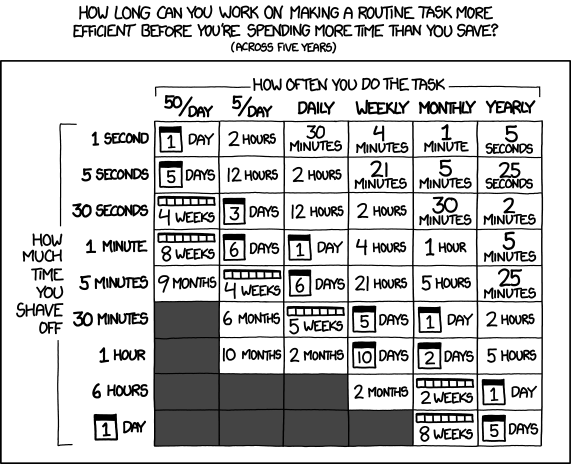
So the ever-educational XKCD has this up as today's comic:


Basically, it's a chart showing you how much time you can spend on making some task more efficient, before you're losing ground.

Now, apply this to RPGs.

Assuming you play once a week (the 4th column in the comic), if there's some task that you can shave one minute off of, you can spend up to 4 hours to make it happen, and it's worth the time you spend. What can you do to shave one minute off some task? (All the numbers apply to a campaign that runs at least 5 years; if yours runs less, decrease the maximum time spent improving the task accordingly.)

One idea is to make things easier to find during play (so you save one minute per week). You could spend up to 4 hours doing any of these, and come out ahead:

  • Put metadata (keywords) in images, electronic map tiles, mp3 files, etc.
  • Sort your miniatures by CL.
  • Make a customized DM screen with the tables you use constantly, not the ones the publisher thinks you should use.
  • Make a list of NPC names.
Or, you could make your life easier when writing adventures. Can you shave 5 minutes off the process? You could spend less than 21 hours doing any of these things, and come out ahead:
  • List all the monsters and animals commonly found in the wilderness, so you don't have to search through the monster book each time you're putting together an encounter.
  • Make detailed lists of NPC encounters (including spells memorized, personalities, magic and mundane items, etc.); rival adventuring parties, merchant caravans, border patrols, tavern inhabitants, etc. Don't be afraid to reuse them.
  • Make a custom index of a supplement or campaign guide you use often.
  • Learn how to use mapping software, so your maps don't take quite as long to make.
These are just a few things off the top of my head. I'm sure you all can think of other ways to make things go just a little bit faster; in the long run, you'll come out ahead. 

(Yeah, I know the comic is making fun of hyper-efficiency, but it doesn't mean it's still not useful sometimes...)
Read More
Posted in DMing tricks, RPG | No comments

Tuesday, 9 April 2013

The Enemy of my Enemy...

Posted on 16:22 by rajrani
One of the things that I don't see mentioned too often in an RPG context is the notion that the bad guys don't always get along with one another. It's a theme that's critical to the classic D1-3 "Descent into the Depths of the Earth" modules (as I discussed a few years ago), but it's not something that gets much talk in my corner of the RPG community.

Having villains that are not only not all on the same team, but who are actively opposed to one another, can add a lot of depth and texture to a campaign. It opens up the possibility of engaging one enemy to oppose another, and can lead to delightfully devious plot twists, as a villain's actions are finally revealed to be directed not at the PCs, but at some other villain.

As an example, let's look at Batman: The Animated Series (one of my favorites for this sort of thing):

  • Two Face hates Poison Ivy, because Ivy tried to kill Harvey Dent before he became Two Face
  • The Joker hates the Creeper, because the Creeper tried to steal his act (and Harley Quinn...)
  • The Joker hates Poison Ivy, because she and Harley Quinn were more successful criminals than he was
  • The Joker, Two Face, and the Penguin hate Dr. Hugo Strange, because they believe he tried to cheat them
  • Clayface hates Roland Daggett, whose Renuyu drug disfigured him permanently
  • Cat Woman hates Roland Daggett, who tried to kill her for interfering with his plan to spread a virulent disease throughout Gotham
  • Cat Woman hates Scarface, who set her up to take the fall for a robbery
  • Two-Face hates Rupert Thorne, who was responsible for his disfigurement and transformation from Harvey Dent into Two-Face
  • Rupert Thorne and Arnold Stromwell are gangland rivals
  • Lock-Up hates just about everyone, because he used to be a guard at Arkham and is now an inmate
There are doubtless others that I'm forgetting, but you get the idea. 

Having such relationships, rivalries, and antagonisms between your villains can be the impetus for a lot of action in the campaign. What if that necromancer isn't raiding the crypts for fresh corpses because of a plot against the town, but rather to attack his great rival the green dragon who lives in the forest? What if the goblins are raiding the village because they heard a rumor that the ogre mage wielding the sword Goblin-Hammer was there? What if the vampire is sending his minions abroad at night not with the intention of terrifying the locals, but in search of the lich who originally killed him years ago? 

Having more complex relationships between your antagonists gives you a way to add layer of richness to your plots. I'm definitely going to explore these sorts of possibilities in my next campaign.
Read More
Posted in Batman, DMing tricks, RPG | No comments

Wednesday, 27 March 2013

Wikipedia is the DMs Friend: 143 Plots to Plunder

Posted on 14:52 by rajrani
I thought I'd start a new, and doubtless to be highly irregular, series on resources from Wikipedia that game masters can use to help with their games. For the first, I'd like to point you to the episode summary for the television show The Adventures of Robin Hood, which aired on the BBC and in the US from 1955-59, and starred Richard Greene.

My wife are watching the show now on DVD (you can get the whole series for under $10 on Amazon!) and while it's often cheesy, it's still a lot of fun and holds up remarkably well if you appreciate it as a product of its time. Richard Greene is one of the better actors I've seen portraying Robin Hood, and the supporting cast is pretty darn good (some of the supporting actors went on to great things on British television - Patrick Troughton, Edward Mulhare, Leo McKern) and Alexander Gauge pretty much defines the role of Friar Tuck. I'd recommend it just as fun television.

There were 143 episodes, and Wikipedia has a comprehensive list of the plots of each. If you're stuck for a plot for your game, you might want to scroll through the list and get some inspiration. For example:
  • Robin & Friar Tuck help a poor serf to enter the Monastery at Whitby. However the young man is forced to flee when the Sheriff has his twin brother thrown into prison on trumped up charges. 
  • When Sir William tries to acquire Tom the Miller's flour mill by underhand means, Robin is soon called in to save the day. 
  • While waiting for a boat to take them back to England, Robin spots Sir Roderick, an emissary of Prince John, disguised as a wine merchant, collecting gold for the Prince. Robin and Tuck contact the French underground via the waitress at the "Black Rabbit" Inn, Michelle, for help in uncovering the plot. Robin & Tuck decide to divert the gold, and a little impersonation is called for. 
  • Lord Guthrie 'steals' his own salt supplies to push the prices up and Robin is blamed. Robin and Little John obtain salt from the coast and Tuck distributes it free until Lord Guthrie's partner, the Sheriff, confiscates it. Another plan is required needing, Roger of Antioch, a "salt diviner". 
  • Robin becomes the latest victim of Sir Hugo DeBask, a lord who arrests travelers through his estate and sets them to work on his lands if they can't pay the fine he imposes at their trial, looking for him Marian also falls into the trap, escape comes from an unexpected quarter.
There are tons more, of course. And as an added bonus, here's the theme song, which fans of Monty Python's Flying Circus might find familiar. Enjoy!

Read More
Posted in DMing tricks, RPG | No comments

Tuesday, 13 November 2012

Oh, Just Roll a 14, Fer Chrissakes!

Posted on 17:56 by rajrani
I'm sure we've all had this happen.

There's a big combat against a large number of lower-level opponents, and the PCs are triumphant (yay!) and there's just mopping up to do.

Trouble is, they just can't seem to do the mopping up. All they need is for one or two of them to roll something higher than a 10 "to hit", and more than a 1 on damage, but they just can't seal the deal. Their dice are laughing their asses off, as they roll an endless supply of 3's and 4's, round after round. Finally, someone mercifully rolls something with double digits, and the last skeleton is finally vanquished.

First of all, it's ridiculous. You can dispatch 12 zombies in two minutes, but that last super-zombie keeps bobbing and weaving for five minutes while four trained warriors keep swishing? Bah.

"Bored now!"
Secondly, it's tedious. Everybody knows the inevitable outcome. Is it really worth going through the aggravation of rolling all those dice over and over just to see if the cleric takes another 3 h.p. of damage before the last orc goes down? FOR THE LOVE OF THOR, JUST ROLL A 14!

When presented with this scenario, I'll just say "you kill it" and move on. But there's another alternative.

It should be possible to come up with a simple table for such (relatively) low-level mooks. Spare us the tedium of rolling over and over just to hit the magic 14; if there's a mook with X hit dice, and the party has Y levels or armor class, someone takes Z damage (some piddling amount, if any) and we move on to greener pastures.

I'd still leave it up to the GM to implement; basically it's a way to justify taking a hit point or three off without the bored "fine, let me roll a d20 yet again" to play it out. The percentages aren't that hard to work out; the basic idea's been around since Chainmail.

But man, I hate when that happens. Just want to finish it without such a blatant "the GM is bored now" finale.
Read More
Posted in DMing tricks, RPG | No comments

Saturday, 10 November 2012

Making Failure an Option

Posted on 21:00 by rajrani
One idea that was floated at the Metatopia convention a week ago was the idea of failure. It came up in the context of a seminar on indie RPGs and their influence on mainstream RPGs. Normally I eschew the "indie RPG scene" because it tends to look down on the OSR (of which I count myself as a proud member), seems  overly involved in self-referential navel-gazing, and is consumed with being new and edgy for the sake of being new and edgy. But I'm certainly not above acknowledging a potentially neat idea when I hear it.

The idea in question was in regards to failing rolls. When a thief has a 20% chance of picking a lock and blows it, or someone has to roll a 14 in order to use their Intimidate skill, or has to make an Intelligence check to do something. Someone on the panel mentioned that some "indie" games don't allow for failure in such instances. The character always performs the task at hand. But if the player fails the roll, Something Bad happens story-wise. It's almost like the player is paying karma back in order to succeed in the mechanical task.

This sort of concept has direct applicability in a game where The Story is paramount. When a character blowing a chance to find a secret door could potentially threaten the ability of the characters to continue with the plot, having such a mechanic in place makes a lot of sense.


Now, picture such a mechanic in an Old School context.


I can see reasons to include such a thing in an Old School type game, where there isn't necessarily a plot that must be followed, so much as there are cool things that the players might otherwise not have the opportunity to discover. Think of it as "the game would be more interesting if he makes the roll." While that runs counter to the ethic of "the dice rule", I think it's a perfectly legitimate attitude to take in some circumstances, inasmuch as it short-circuits the impulse to fudge a dice roll, because failure actually makes the game more interesting all around. I don't see that as necessarily a bad thing (bearing in mind that "the dice rule" can also make the game more interesting, depending on the circumstance).

If the thief misses his pick locks roll, he still manages to open the door, but there's an automatic wandering monster the next round.

If the bard misses his Charisma check, he still talks his way into the Duke's daughter's birthday ball, but one of the courtiers develops a crush on him, and clings to him for the entire evening, making whatever his actual mission is very difficult.

If the savant misses his Scholarship roll, he still knows where to find the book that has the nugget of information he's seeking, but it's in a private library under the care of someone he studied with as an apprentice, who hates his guts and will doubtless throw up all kinds of road blocks to accessing the book.

Etc. etc. etc.

I don't think such a mechanic would work universally in an Old School game, because one of the tropes of our style of play is that you're not a superman and often when you fail that means you need to use your imagination to think of an alternative. But, given the ethos of "fun is better than tedium", I can see a GM employing such a mechanic in specific situations or at his whim, if it's obvious that doing so will open up new opportunities for interesting interactions.

Given that criterion, I'd probably not want to open it up to the players' choice (by earning "story points" or whatever the kids at RPG.net are pushing nowadays), precisely for the reason that they can't know where the best opportunities for such exist in the game. But I do think it's worth considering, and offers a neat mechanical alternative to simply fudging a roll; if you do fudge a roll, it becomes an opportunity to bring in more consternation for the PCs to have to manage.

And, as long as it increases the fun, I'm inclined to like it. 
Read More
Posted in Conventions, DMing tricks, RPG | No comments

Sunday, 21 October 2012

13 Days of Halloween: Day Three

Posted on 09:18 by rajrani
What really scares you?

I mean, what is your innermost, deepest, if-Freddy-Krueger-were-after-me-this-is-how-he'd-kill-me fear?

Lots of people are scared of heights, or spiders, or snakes, or whatever; many to the point of actual phobia. But deep down inside there's got to be something much more fundamental. Something that fills you with existential dread to the point where it's difficult to even imagine, much less articulate. It's often a theme in our nightmares, although it doesn't have to be literally played out there. Often a hint is enough.

For me, it's immobility.

The thought of being trapped in my own body, watching the world go by around me, completely unable to interact with it, helpless to defend myself... *shudder*

I think I don't play on these possibilities enough while running a game. For instance, to use the above example, when a character is immobilized by some undead creature, rather than just saying "You're frozen for the next 6 rounds", you could get a lot of atmosphere by saying something more evocative like "The ghoul touches you and you feel your muscles freeze, turning to stone. You can still see and hear everything around you, can catch glimpses of your comrades fighting the creatures out of the corner of your eye, but you are just standing there, a completely immobile spectator, waiting for the outcome, unable to affect it."

So, what really scares you?
Read More
Posted in 13 Days of Halloween, DMing tricks | No comments

Tuesday, 3 July 2012

How Do You Like Your Stat Blocks?

Posted on 10:06 by rajrani
I've been giving some thought lately to just how stat blocks should best be handled. Now, I'm the sort of DM who always plays with a copy of the Monster Manual (or should I say Bestiary) close at hand, so I always have the full entry of any monster right with me as needed. Normally, when I'm writing a dungeon just for myself, all I'll include are hit points and any variable data as needed (sub-types, variable hit dice or armor class, etc.).

But sometimes I do like having a little more information, and have been fiddling around with some ideas. Some examples:

A) Four wererats in rat-man form are here (15,16,16,17 h.p.) armed with long swords and 12 darts each. If they are able, they will warn the inhabitants of area #17 of any intruders.

B) Four wererats in rat-man form are here (3d10 HD; 15,16,16,17 h.p.; AC 6) armed with long swords and 12 darts each. If they are able, they will warn the inhabitants of area #17 of any intruders.

C) Four wererats in rat-man form are here (3d10 HD; 15,16,16,17 h.p.; AC 6; DAM per weapon; DEF immune to non-magical or non-silver weapons; ATK can shift into human, giant rat, or rat-man form) armed with long swords and 12 darts each. If they are able, they will warn the inhabitants of area #17 of any intruders.

D) Four wererats in rat-man form are here armed with long swords and 12 darts each. If they are able, they will warn the inhabitants of area #17 of any intruders.
Wererats: 3d10 HD; 15,16,16,17 h.p.; AC 6; DAM per weapon; DEF immune to non-magical or non-silver weapons; ATK can shift into human, giant rat, or rat-man form.

Now, these examples go from most stripped-down to most elaborate. A is what I use mostly for myself, B has the bare minimum information I need (on the general rule that I'll remember which creatures have special abilities and thus need to be looked up), C has the full-blown stat block in-line with the text, while D has the stat block called out and indented.

Obviously, these aren't an exhaustive set of examples; many more ways exist of getting the needed information in front of the DM (one, listing all of the relevant stats of the monsters at the back of the module, is something I've always just despised for some reason-- I'd much rather have the book open).

What do you think? What's your preferred way of seeing monster stats in a module, and why?
Read More
Posted in 1E, ADD, DMing tricks, RPG | No comments

Friday, 27 January 2012

The Fifteen Minute Workday

Posted on 15:53 by rajrani
One of the things that plagues some D&D games (my own included, on occasion) is what is known as "the fifteen minute workday problem". To wit, characters in a dungeon go through two or three rooms, find themselves down some hit points and/or spells, and then return to the surface, heal up and re-memorize spells to return on the next day. Or, alternatively, they barricade themselves in a room and camp out in the dungeon itself. It's a problem that especially presents itself in lower-level games, because the spell casters have few spells and must recharge more often.

There are some tricks a game master can employ in order to discourage this behavior. Locking the player characters in the dungeon (whether literally or by simply denying them egress through having them get lost, having monsters block the exit, etc.), disrupting spell-casters' rest with random encounters, etc. But it's very easy to overdo these sorts of things, however, and can begin to smack of "the DM is just going to punish us for leaving, so we might as well keep going until we're dead" in the minds of the players.

4E attempted to address this problem at least in theory with its classification of powers as being per-encounter, per-day, etc. To my mind, however, that was a bit too "gamey", and lacked any sort of real in-game justification. But the problem is certainly not unique to 4E; it's existed since the beginning of the game.

I wonder, though, if there is some way of addressing this issue in a way that doesn't offend my grognardly sensibilities? On the one hand, part of the whole aesthetic of an old-school game is resource management. It's not just about making the right tactical choices in a combat, but making the right operational choices when selecting spells and buying equipment. In once sense, the megadungeon is its own solution to the problem; if the game master doesn't slack off when it comes to rolling for random encounters, the mere fact that the player characters may well need to fight their way out will encourage them to stay in longer. But that just shifts the site of rest to a barricaded room inside the dungeon, rather than the local inn or convenient cave near the site of the dungeon.

There is one solution to the problem, which applies perhaps more to the megadungeon environment than a smaller encounter area, but I'm sure the principle could be applied.

The monsters get tougher (or, perhaps, more wary) if the player characters keep coming in and doing hit-and-run sortees.

Not in the sense that they somehow get bonuses to hit, or more hit dice, but in the sense that they become more organized. They're more on their guard. Patrols are more frequent. Rooms and corridors are restocked with guards, ready to send out messengers to alert the leader to the renewed presence of the intruders. Once the player characters clue into the fact that the monsters will be waiting for them (perhaps even with traps, ambuscades, tougher monsters from deeper within the dungeon who are brought up as reinforcements, etc.), they may decide that two-rooms-a-day is not the best way to go. Maintaining the momentum, and thereby the element of surprise, becomes a superior (and thus preferable) strategy.

Naturally, this doesn't mean that resistance can't stiffen during the player characters' foray. Just because they haven't returned to the surface doesn't mean that the orcs will automatically stay in their rooms, conveniently grouped in 3's and 4's, perfect for slaughter and easy x.p. But that should be a more "ad hoc" thing on the part of the defenders (except for those very lawful humanoid tribes that have contingency plans already in place, complete with pole-arm-wielding troops to command narrow corridors and such), and to be expected. The idea is that pressing on should be the preferable option to retreat, except when the resources of the party really are exhausted, and R&R becomes required.
Read More
Posted in 4E, DMing tricks, RPG | No comments
Older Posts Home
Subscribe to: Posts (Atom)

Popular Posts

  • More Greyhawk Heraldry
    I thought I'd knock out some of the easier ones this time. As before , these were done using the wonderful Coat of Arms Visual Designer ...
  • Yet More Greyhawk Heraldry
    I needed to take a writing break, so in my idle moments I put together some more heraldic devices from the World of Greyhawk. As before, the...
  • Mapping Beyond the Flanaess: Eastern Suhfang and Orcreich, Gulf of Ghayar
    I'm on a roll! Behold another effort in my Mapping Beyond the Flanaess series. This map covers the eastern portion of the Celestial Impe...
  • Ships!
    As careful readers of the blog will recall, I've been in the process of putting together a fleet of late Medieval / early Renaissance sh...
  • The Beanstalk: An Alternate Setting for Metamorphosis Alpha/Gamma World
    Much as I love the venerable Metamorphosis Alpha, I was never too taken by the setting of the Starship Warden. The design of the ship (essen...
  • A Question on Alignment
    One of the players in my home campaign, who is also doing some editing/proofreading work on the Adventures Dark and Deep Players Manual, cam...
  • On Transhumanism in RPGs
    From time to time, various RPGs present themselves that are billed as being transhumanist in nature. As a transhumanist myself for more than...
  • Memphis, Capital of Mighty Erypt
    "Surrounded by gigantic walls , mighty Memphis stood before us ; no other city in E rypt was so beautiful , so great, so rich...
  • Dexcon schedule now up!
    The complete schedule of events for this years's Dexcon convention in Morristown, NJ over Independence Day weekend is now up. Lots of r...
  • Mapping Beyond the Flanaess: All Together Now!
    Well here we are. The final corrected versions of the maps are now all gathered into a .rar file (link to the right in the "Free Resour...

Categories

  • 0E (3)
  • 13 Days of Halloween (11)
  • 1E (18)
  • 2E (7)
  • 3E (3)
  • 4E (4)
  • 5E (28)
  • ADD (76)
  • Admin (5)
  • AGG (3)
  • animation (3)
  • Apes (1)
  • appearances (5)
  • Aquaria (1)
  • arrows of indra (1)
  • art (4)
  • Batman (5)
  • Black Blade (1)
  • Blogosphere douchebaggery (1)
  • Board Games (25)
  • Books (13)
  • BRW Games (22)
  • Campaign Design (8)
  • Campaign Journal (4)
  • card games (2)
  • Cartography (21)
  • Castle Greyhawk (1)
  • Castle of the Mad Archmage (11)
  • Character Classes (2)
  • Chroniques de la Lune Noire (6)
  • City of Greyhawk (3)
  • Combat (3)
  • Computer Games (2)
  • Conventions (25)
  • DCC (5)
  • Derp (2)
  • Design Theory (1)
  • DMing tricks (10)
  • Doctor Who (1)
  • Erseta (20)
  • fandom (4)
  • Fantasy Flight Games (3)
  • Field of Glory (12)
  • Film Reviews (9)
  • films (34)
  • forgotten realms (2)
  • Game Design (23)
  • Game of Thrones (1)
  • Game Reviews (5)
  • Games I Love (1)
  • games workshop (3)
  • Gaming Industry (23)
  • Gamma World (1)
  • Glitterdark (4)
  • Greyhawk Comics (2)
  • Greyhawk Novels (8)
  • Grognardish Grumpiness (1)
  • Gygax (4)
  • Gygax Magazine (4)
  • Heraldry (4)
  • history (20)
  • horror (2)
  • Iron League Campaign (2)
  • John Carter film (2)
  • Kenzer (1)
  • Kickstarter (17)
  • LARP (2)
  • LotFP (2)
  • Magic (4)
  • Mass Battle (1)
  • megadungeons (4)
  • Mentzer (1)
  • Metamorphosis Alpha (1)
  • Miniatures (59)
  • monsters (10)
  • Music (2)
  • My Campaign (18)
  • NaGaDeMon (2)
  • News (20)
  • Ogre-GEV (20)
  • Old School (9)
  • Pathfinder (4)
  • PBM games (1)
  • Play Theory (2)
  • Religion (1)
  • Retro Clones (3)
  • RPG (349)
  • RPG Blog Carnival (1)
  • RuneQuest (1)
  • Satanic panic (1)
  • Savage Worlds (1)
  • Setting Design (2)
  • Skills (1)
  • Space (5)
  • Star Trek (11)
  • Star Wars (7)
  • Stronghold Games (2)
  • Sundered Empire (4)
  • superheroes (1)
  • T1-4 (1)
  • Television (13)
  • The RPG Industry (17)
  • Tolkien (7)
  • Traveller (1)
  • TSR (2)
  • UE (1)
  • Video Games (1)
  • Wargames (60)
  • Whimsy (40)
  • World of Greyhawk (54)
  • Worthy Causes (6)
  • WotC (30)

Blog Archive

  • ▼  2013 (124)
    • ▼  June (14)
      • Bestiary Cover
      • Dexcon schedule now up!
      • Vin Diesel on D&D and Riddick
      • Bestiary Art
      • Review: Against the Slave Lords
      • Top Five Star Trek Episodes
      • Monster Books
      • Essential High Fantasy
      • Magic as cargo cult
      • My Favorite NPC: Vert
      • Climate, barbarian migrations, and icebergs full o...
      • Adventures Dark and Deep Character Sheet Contest!
      • Kickstarter after-action report
      • On Transhumanism in RPGs
    • ►  May (29)
    • ►  April (15)
    • ►  March (21)
    • ►  February (27)
    • ►  January (18)
  • ►  2012 (335)
    • ►  December (29)
    • ►  November (16)
    • ►  October (30)
    • ►  September (16)
    • ►  August (23)
    • ►  July (30)
    • ►  June (29)
    • ►  May (32)
    • ►  April (45)
    • ►  March (26)
    • ►  February (24)
    • ►  January (35)
  • ►  2011 (41)
    • ►  December (37)
    • ►  November (4)
Powered by Blogger.

About Me

rajrani
View my complete profile